The Philosophy

A verb, not a position.

The High Consciousness Philosophy, and where it stands among two hundred theories of consciousness.

The Landscape

Two hundred answers to one question.

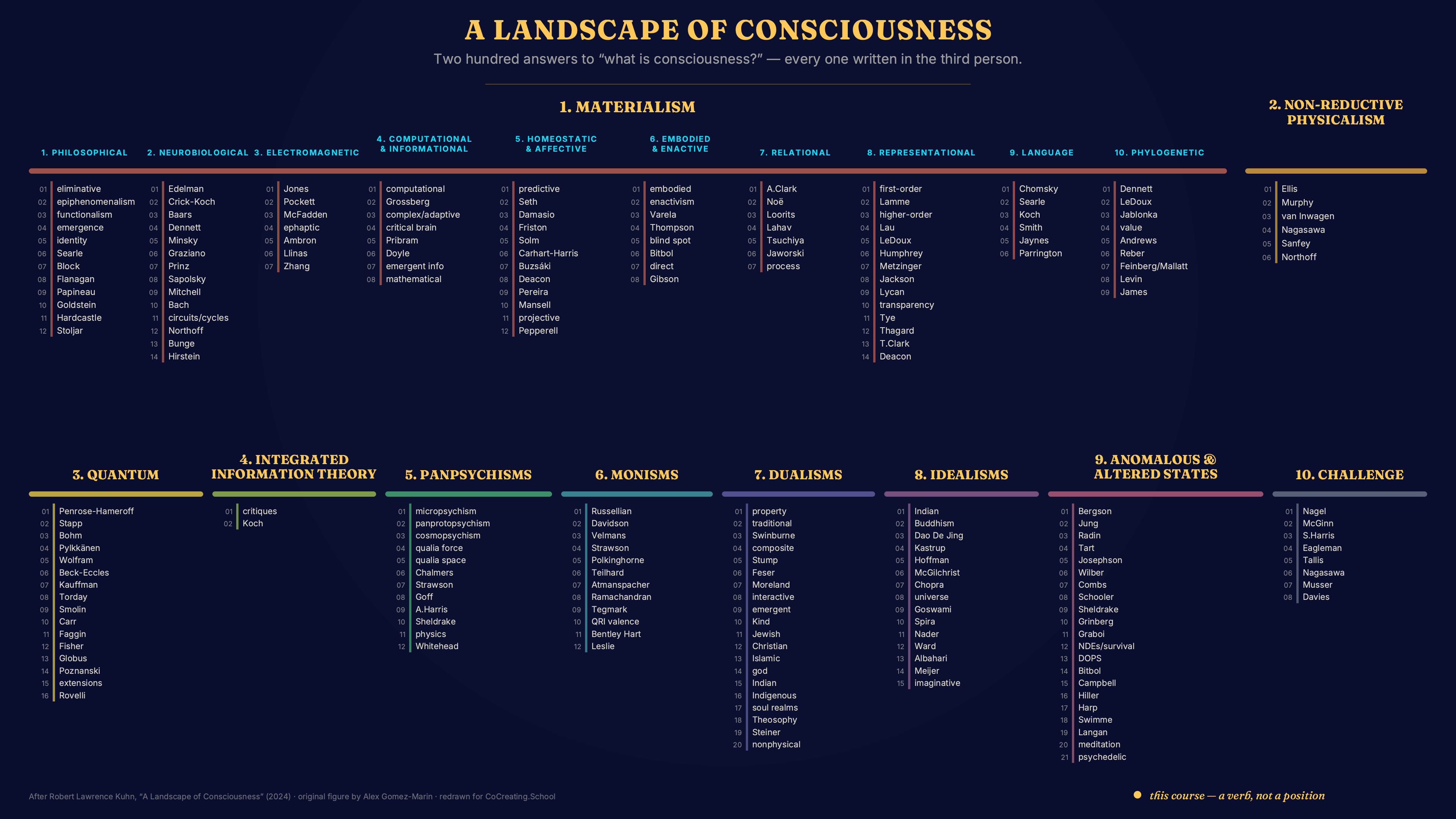
This is the academic map of consciousness: materialisms, quantum theories, panpsychisms, dualisms, idealisms. Two hundred positions, every one written in the third person. Consciousness described from outside, as an it.

A Landscape of Consciousness: ten families of consciousness theories with roughly two hundred named positions
After Robert Lawrence Kuhn, "A Landscape of Consciousness" (2024). Original figure by Alex Gomez-Marin; redrawn for CoCreating.School.

This school takes no seat on that map.

The Cornerstone

One fact, one assumption.

We begin from the one fact nobody can deny: your conscious experience is real as itself. Not as brain activity described from elsewhere, not as illusion. Real, as lived. Doubting it is already experience.

On that fact, the philosophy makes its one working assumption, its cornerstone: consciousness is fundamental. Consciousness creates the brain and all matter, exactly as materialism simply assumes matter to be fundamental and builds everything on that.

We do not argue this assumption. We work from it, and judge it the way we judge everything here: by its fruits.

The Standard

Being right is not the goal.

Ideas are held to a working standard, the three tests:

Stability

Does it hold you when life shakes?

Fruits

What does it produce over time, in you and around you?

Verifiability

Can you test it in your own experience?

A belief that passes is worth keeping, whichever cell of the map it came from.

For Those Who Help Others

Taught the way medicine teaches.

The philosophy travels into any practice: coaching, psychology, spiritual direction. It demands no conversion, because it asks for an assumption, never a creed.

And it is taught the way medicine trains doctors: on cases, with supervision. The practitioner commits to a read before the teacher speaks. Rounds, for consciousness work.

The practitioners' path →

The philosophy is written in Spiriduality. The conversation lives in the podcasts. This school is where it becomes practice.

See the courses